Frozen yogurt bark is yogurt spread thin on a lined tray, topped with fruit, nuts or a little chocolate, frozen until firm and snapped into pieces. Prep takes about 10 minutes, the freezer does the rest in roughly 3 hours, and one tray gives you a week’s worth of cold snacks. Below you’ll find our base recipe, topping combinations, ways to keep sugar in check, and how to store it so it tastes as good on day 20 as on day one.
Fast Recipe for Yogust Bark:
Spread 2 cups of plain Greek yogurt about 1/4 inch thick on a parchment-lined sheet pan, add toppings, and freeze at least 3 hours.
Plain yogurt plus whole fruit keeps added sugar low. Sweeten lightly, or not at all for kids under 2.
A tray cuts into 16 to 32 pieces, and a heart-healthy version works out to 67 calories per serving.
Store pieces in an airtight container with parchment between layers and eat within 1 to 3 months for the best texture.
Serve straight from the freezer: bark softens fast.
Table of Contents
What frozen yogurt bark is, and why it works
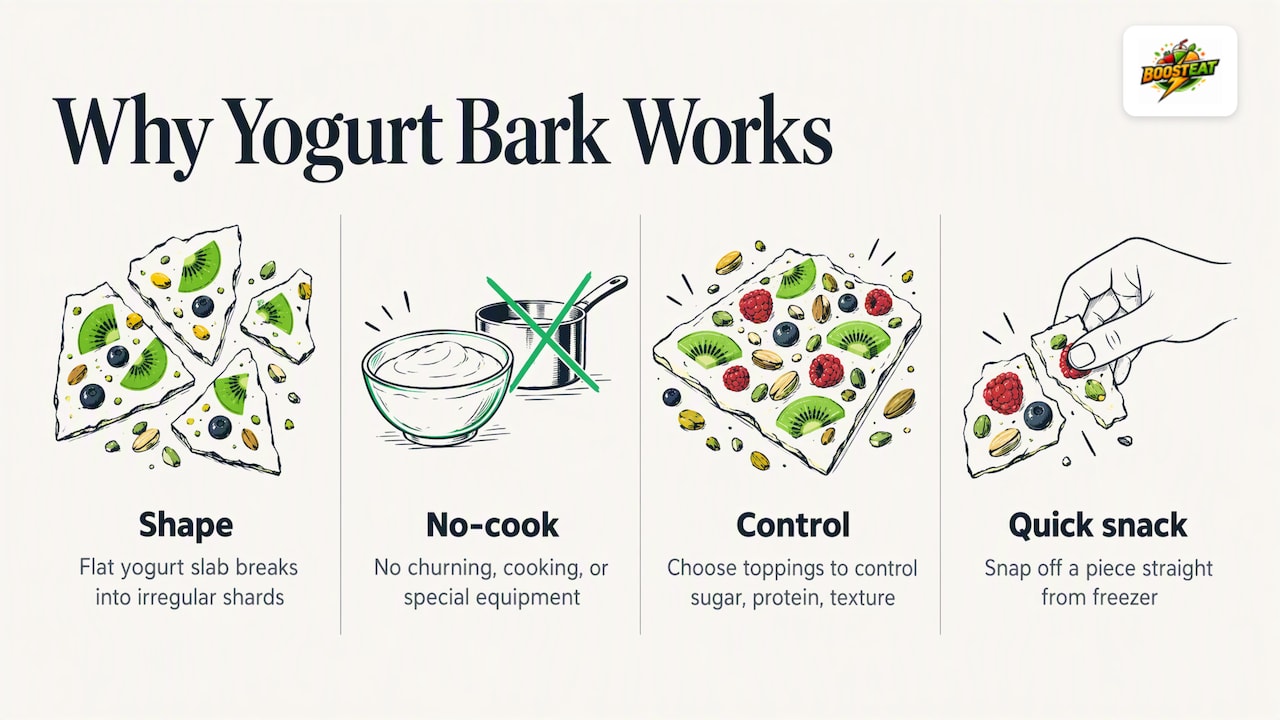
The name comes from chocolate bark: a flat slab you break into irregular shards. Swap the chocolate for yogurt and you get something creamy, tangy and cold, closer to a frozen cheesecake bite than to ice cream. There is no churning, no cooking and no special equipment.
It also fits real life. Busy mornings, after-school hunger, a hot afternoon: you open the freezer, snap off a piece, and you’re done. Because you choose the yogurt and the toppings, you control the sugar, the protein and the texture. That is the main reason it shows up so often in public-health recipe collections, such as the University of Maine Cooperative Extension’s nutrition education program and Health Canada’s food guide kitchen, which describes its berry version as freezer-friendly, kid-friendly and no-cook.
The base recipe
This is the template we come back to. Once you know it, every other version is a swap.
Time: 5 to 10 minutes of prep, at least 3 hours of freezing (American Heart Association recipe).
Makes: about 16 to 24 pieces, depending on how thick you spread it and how big you break it.
Ingredients
2 cups plain Greek yogurt (whole milk gives the creamiest bite; low-fat works too)
1 to 2 tablespoons honey or maple syrup, optional
1/2 teaspoon vanilla extract
1 1/2 cups mixed fruit, such as sliced strawberries, blueberries and raspberries
2 to 3 tablespoons chopped nuts, seeds or granola
Steps
Line a rimmed baking sheet with parchment paper. A quarter sheet pan gives thicker bark, a half sheet gives thinner, crunchier pieces.
Stir the yogurt with the vanilla and sweetener, if using. Taste it. Cold dulls sweetness, so it should taste slightly sweeter than you want the finished bark.
Spread the yogurt into an even layer about 1/4 inch thick, using the back of a spoon or an offset spatula.
Scatter the fruit over the top, then the nuts, seeds or granola. Press lightly so the toppings stick.
Freeze, level, for at least 3 hours, until completely firm.
Lift the parchment out, and break or cut the slab into pieces. A knife gives tidy squares, and your hands give rustic shards.
A few details make the difference:
Even thickness matters. Thin spots freeze brittle and thick spots stay soft. Tap the pan on the counter once to settle the yogurt.
Dry your fruit. Wet berries leave icy patches. Pat them with a paper towel first.
Chop large fruit small. Whole strawberries freeze rock-hard and are tough to bite through. Slices or quarters are easier, especially for kids.
Work quickly at the end. Bark softens within minutes at room temperature, so break it up and get it back into the freezer.
Choosing your yogurt
The yogurt is 80 percent of the bark, so it sets the texture and the nutrition.
Greek yogurt is thick, high in protein and tangy. It spreads in a stable layer and freezes into a dense, creamy slab. It’s our default.
Regular plain yogurt is looser. It can still work, but it freezes icier and may need a thicker layer. Strain it through a cheesecloth for 30 minutes if it looks watery.
Flavored yogurt is the shortcut many popular recipes use, and the bark is fine, but the added sugar climbs quickly. A cup of vanilla yogurt can carry more sugar than you’d add yourself with a spoonful of honey, so check the label.
Dairy-free yogurt (coconut, soy or almond) makes the bark vegan. Pick a thick, unsweetened variety. Coconut-based yogurts freeze firmer and may need a minute or two to soften before you bite in.
Topping combinations worth making
You can top bark with almost anything, but a good combination balances something juicy, something crunchy and something rich. Each of these uses the base recipe above.
Fruit yogurt bark
The classic. Strawberries, blueberries and raspberries bring color and tartness against the creamy yogurt. Mango and kiwi give a tropical version, and sliced peaches suit late summer. Berry versions appear across the recipe collections of EatingWell, which lists chopped chocolate, fruit preserves, toasted nuts, seeds and granola among the usual toppings.
Chocolate yogurt bark
Melt 1/4 cup of dark chocolate chips with a teaspoon of coconut oil, cool for a minute, and drizzle in thin lines over the yogurt. Or skip melting: scatter mini chips or finely chopped dark chocolate and press them in. Drizzled chocolate hardens as it freezes and snaps neatly, which gives you that real bark texture. Strawberries and chocolate are a natural pair, and EatingWell’s strawberry-chocolate Greek yogurt bark is built on exactly that idea.
Peanut butter and banana
Stir 2 tablespoons of natural peanut butter into the yogurt, swirl another tablespoon on top, and add thin banana slices and a few dark chocolate chips. It’s the most filling version, good after a workout or as a lunchbox snack. Use sunflower seed butter if your school bans nuts.
Healthy yogurt bark for breakfast
Top plain Greek yogurt with blueberries, chopped walnuts, chia seeds and a sprinkle of cinnamon. No sweetener at all. It tastes like frozen breakfast yogurt, and a piece with a banana is a fast morning option when you’re running late.
Greek-inspired bark
We love anything with a Mediterranean accent. Try thick Greek yogurt with a thread of honey, chopped pistachios or walnuts, a pinch of cinnamon and a few pomegranate seeds or sliced figs. It reads like the classic Greek yogurt with honey and nuts, only frozen.
Quick topping reference
| Goal | Yogurt | Toppings | Sweetener |
|---|---|---|---|
| Lowest sugar | Plain Greek | Raspberries, chia, cinnamon | None |
| Kid-friendly | Plain Greek | Soft sliced strawberries, blueberries, a few mini chips | 1 tablespoon maple syrup |
| Protein-forward | Plain Greek | Peanut butter swirl, banana, hemp seeds | Optional |
| Dessert-style | Plain or vanilla Greek | Dark chocolate drizzle, toasted almonds | 1 to 2 tablespoons honey |
| Vegan | Unsweetened coconut or soy | Mango, coconut flakes, pumpkin seeds | Maple syrup |
Keeping sugar in check
Yogurt bark has a health halo, and it deserves one only if you build it carefully. A slab made of sweetened vanilla yogurt, jam and candy is dessert, which is fine, but it isn’t the same snack as plain yogurt with berries.
The Dietary Guidelines for Americans recommend keeping added sugars under 10 percent of daily calories, which is about 50 grams on a 2,000-calorie diet, and none at all for children under 2. The sugar in plain yogurt and whole fruit is naturally occurring, so it doesn’t count toward that limit. Honey, syrup, jam and sweetened yogurt do.
Practical ways to stay under the line:
Start with plain yogurt. It’s the biggest single lever.
Sweeten the yogurt, not every topping. One tablespoon of honey across a whole tray is a few grams per piece.
Let fruit do the work. Ripe mango, banana and berries add sweetness along with fiber.
Go light on candy and dried fruit. Dried fruit is concentrated sugar. A small handful is plenty.
Read labels. “Greek-style” and “light” yogurts can still be sweetened.
The same label-reading habit pays off across your day. If you’re also trying to cut sugar from drinks, this guide to electrolytes without sugar shows how to look at what’s actually in the bottle.
Making it for children
Bark suits kids because they can help: spreading, sprinkling and breaking are all jobs for small hands. For toddlers under 2, skip honey, syrup and jam entirely, in line with the guidance above, and let the fruit provide sweetness. Cut berries into small pieces, and leave out whole nuts and large seeds for young children because of the choking risk. Break the bark into pieces small enough to eat in a couple of bites, and always supervise.
For older kids, a tablespoon of maple syrup across the tray, mini chocolate chips and sliced strawberries create a treat that feels like dessert and still delivers protein and calcium.
Nutrition: what to expect
Numbers depend on your yogurt and toppings, but the American Heart Association’s recipe lists 67 calories, 5 grams of protein and 1 gram of fiber per serving, with 1 gram of total fat. That’s a useful benchmark for a plain Greek yogurt and fruit version. Add peanut butter, chocolate and granola, and a piece will land higher. That’s fine, just count it as a more substantial snack.
One piece of bark won’t replace a meal. Pair two pieces with a piece of fruit or a handful of nuts, and it gets close to a light breakfast or afternoon snack. If you’re building a balanced day, the Dietary Guidelines’ healthy eating pattern puts whole fruits, whole grains and low-fat dairy, including yogurt, at the center, and bark fits right in.
Storing frozen yogurt bark
Most of the bark’s quality problems come from storage, not from the recipe.
Use an airtight container or freezer bag. It keeps out odors and freezer burn.
Layer with parchment. Put a sheet between layers so pieces don’t fuse. The University of Maine Extension also suggests parchment directly on the surface before sealing, to stop the top from drying out or absorbing freezer smells.
Eat within 1 to 3 months. The USDA says yogurt keeps in the freezer for 1 to 2 months for best quality, and Maine’s guidance stretches it to 3. In practice, a tray rarely lasts that long.
Serve from the freezer. The American Heart Association notes that bark begins to melt within about 15 minutes out of the freezer. Take out only what you’ll eat.
Don’t refreeze melted bark. If it has gone soft and sat out, stir it into a smoothie or oatmeal instead.
If the bark is too hard to bite right out of the freezer, give it a minute on the counter. A thinner layer solves the problem for good.
Troubleshooting
The bark is icy. The yogurt had too much water, or the fruit was wet. Use thick Greek yogurt and pat fruit dry.
It won’t break cleanly. It’s probably too thick, or too soft. Freeze it longer, or score it with a knife and snap along the lines.
The toppings fall off. Press them gently into the yogurt before freezing. For a stickier surface, add a thin swirl of nut butter.
It tastes bland. Cold mutes flavor. Add a pinch of salt, a little vanilla or a squeeze of lemon juice to the yogurt.
It sticks to the parchment. Let it sit for a minute, then peel the paper away from the bark, not the other way round.
Our perspective on yogurt bark
At Boost Eat, we think about snacks the way we think about smoothies: the best ones are simple, made from wholesome ingredients, and flexible enough that a family with different needs can all enjoy them. Yogurt bark ticks each box. One tray can be vegan, low in sugar, nut-free or a little indulgent, depending on who is eating and what’s in the pantry.
We also believe the best healthy recipe is the one that gets made twice. That’s why we like a base-plus-swaps approach: learn one method, then change the fruit with the season. If you already blend smoothies, you have everything you need. Leftover berries, half a banana and the last of the yogurt tub can all end up on a tray rather than in the bin.
Our one firm piece of advice is to taste your yogurt before you buy it. Sugar creeps into “healthy” products quietly, and plain yogurt gives you control. Start there, add fruit, and treat sweetener as seasoning rather than a foundation.
— Simos Boost-eat.com Founder
More recipes, delivered to your kitchen
If you like recipes that take 10 minutes and use ingredients you already know, our Member’s Kitchen is built for you. It’s $7 per month, and you can join Boost Eat Member’s Kitchen to keep our healthy snack, smoothie and dessert ideas close at hand. You can also browse the premium recipes on the Eat Boost Eat app and read more about who we are.
Frequently asked questions
How do I make yogurt bark?
Spread plain or Greek yogurt about 1/4 inch thick on a parchment-lined sheet pan. Add sliced fruit, nuts or granola, and freeze for at least 3 hours until solid. Break it into pieces and serve straight away.
How long does frozen yogurt bark last in the freezer?
For the best texture and flavor, eat it within 1 to 3 months. The USDA’s guidance for frozen yogurt is 1 to 2 months for best quality. Keep the pieces in an airtight container, with parchment between layers.
Is Greek yogurt bark healthy?
It can be a balanced snack when you use plain Greek yogurt, whole fruit and limited sweetener. A plain version lists about 67 calories and 5 grams of protein per serving in the American Heart Association’s recipe. Sweetened yogurt, candy and heavy chocolate toppings push it toward dessert.
Can I make yogurt bark without sweetener?
Yes. Ripe berries, banana and mango add enough natural sweetness for most people, and a little vanilla or cinnamon rounds out the flavor. For children under 2, leaving out added sugars is the official recommendation.
Why is my yogurt bark so hard?
Greek yogurt freezes firm, especially in a thick layer. Spread it thinner, or let a piece sit for a minute or two before eating. A little fat helps, so whole-milk yogurt or a swirl of nut butter gives a softer bite.
Sources
Frozen Yogurt Bark, University of Maine Cooperative Extension
Talk to Your Patients and Clients About Healthy Eating Routines, Dietary Guidelines for Americans
How to Build a Healthy Eating Pattern, Dietary Guidelines for Americans
Discover more from BOOST EAT
Subscribe to get the latest posts sent to your email.

