Here is the short version: stir rolled oats, peanut butter, honey and ground flax together, fold in chocolate chips, chill the dough, and roll it into balls. No oven, no mixer, and about 15 minutes of work. The recipe below makes around 20 balls, and every ingredient can be swapped, so you can adapt it to a nut allergy, a vegan diet or a lower-sugar kitchen.
This is the base recipe we reach for when someone asks for a snack that is quick, filling and easy to hand to a child, a coworker or yourself at 3 p.m. After the recipe you will find the ratios that make any version work, five tested directions to take it, honest numbers on calories and sugar, and storage advice.
Key takeaways
The base recipe needs five core ingredients (oats, peanut butter, honey, ground flax, chocolate chips), takes about 15 minutes and uses no oven.
Energy balls are a calorie-dense snack: public-health recipes put a ball at roughly 90 to 150 kcal, so portion size matters as much as ingredients.
Honey, maple syrup and dates all count as free or concentrated sugars, so keep the sweetener to the minimum your dough needs.
A wet-to-dry ratio you can adjust by the spoonful lets you swap nut butters, seeds and mix-ins without a failed batch.
Chilling the dough for 30 to 60 minutes makes rolling easier and keeps the balls firm.
Table of Contents
The base energy balls recipe
This version is intentionally plain. Once you have made it once, you will understand how the dough behaves and can improvise with confidence.
Prep time: 15 minutes. Chill time: 30 to 60 minutes. Makes: about 20 balls, each roughly 1 inch across.
Ingredients
1 cup old-fashioned rolled oats
1/2 cup ground flaxseed (flax meal)
1/2 cup creamy peanut butter
1/3 cup honey (maple syrup for a vegan version)
1/2 cup mini chocolate chips
1 teaspoon vanilla extract
A pinch of fine salt
The five “anchor” ingredients are oats, flax, peanut butter, honey and chocolate. Vanilla and salt are small additions, but they make the balls taste like a treat instead of a health bar.
Method
Combine the dry ingredients. In a medium bowl, stir the oats, ground flax and salt together.
Add the wet ingredients. Add the peanut butter, honey and vanilla. Stir with a sturdy spoon until the mixture looks crumbly but starts to clump.
Fold in the chocolate chips. Add them last so they do not melt into the dough.
Check the texture. Press a spoonful in your palm. It should hold together without crumbling or leaving a greasy film. If it is dry, add peanut butter or honey a teaspoon at a time. If it is sticky, add a spoonful of oats or flax.
Chill. Cover the bowl and refrigerate for 30 to 60 minutes. Cold dough is firmer and far less messy.
Roll. Scoop level tablespoons and roll them between clean palms. Slightly damp or lightly oiled hands stop the dough from sticking.
Store. Move the balls to an airtight container and keep them in the refrigerator.
The formula is not unusual. Public-health and extension programs publish nearly identical versions: a Veterans Affairs oncology cookbook lists an energy ball made from oats, ground flaxseed and nut or seed butter with a one-hour chill, and a VA high-calorie snack handout gives a 10-minute no-bake bite with oatmeal, coconut flakes, peanut butter and ground flax. When institutions that care about nutrition converge on the same structure, it is a sign the structure works.
Why this ratio works
Every energy ball is built from the same four parts. Once you see them, you no longer need a recipe.
| Part | Job in the dough | Examples | Rough starting amount |
|---|---|---|---|
| Base | Bulk and chew | Rolled oats, oat flour, shredded coconut | 1 cup |
| Binder | Holds everything together | Peanut, almond or sunflower seed butter, tahini | 1/2 cup |
| Sweetener | Sticky glue plus flavor | Honey, maple syrup, mashed dates | 1/4 to 1/3 cup |
| Boosters | Fiber, protein, texture | Ground flax, chia, hemp, chopped nuts, chocolate chips | 1/2 to 3/4 cup total |
The binder and the sweetener are the wet side. If you change one, rebalance the other. Swapping peanut butter for a runnier almond butter, for example, usually means adding a few extra spoonfuls of oats. Swapping honey for a thicker date paste often means you can use a little less of it.
Dry boosters such as ground flax soak up moisture, so they need slightly more wet ingredients. Whole seeds and chocolate chips do not absorb anything, so they add texture without changing the dough.
Five variations to try
These all start from the same base and change only a few ingredients.
1. Classic peanut butter chocolate
The recipe above. It is the one kids ask for by name and the easiest to scale up for a school event or a week of lunchboxes.
2. Nut-free sunflower seed butter
Swap the peanut butter for sunflower seed butter and use seeds (pumpkin or hemp) instead of any chopped nuts. Check labels on chocolate chips and oats, since some are processed in facilities that also handle nuts. If you are packing these for a school with a nut-free policy, read the school’s rules first, because some also ask for products made in certified nut-free facilities.
3. Strawberry almond
Fruit-based balls use dates as both sweetener and glue. A North Dakota State University Extension recipe starts with a cup of Medjool dates, strawberries and sliced almonds, which shows how far you can go from the oat-and-peanut-butter template. These balls are softer and best kept cold.
4. Coconut and chia
Swap the flax for 1/4 cup chia seeds and roll the finished balls in unsweetened shredded coconut. The Iowa State University Spend Smart Eat Smart recipe combines oats, unsweetened coconut flakes, chia seeds, mini chocolate chips and creamy peanut butter, which is a good model for this one.
5. Greek-inspired tahini and honey
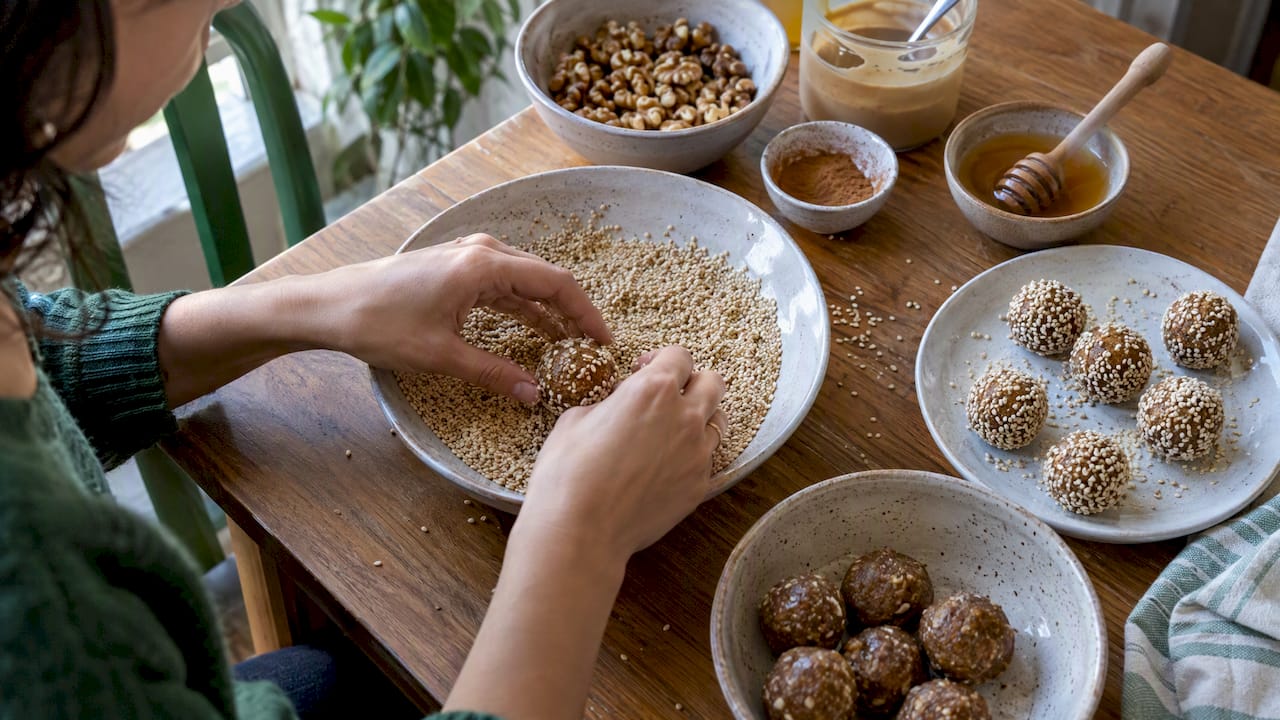
This is the direction we like most at Boost Eat, given our focus on Greek cooking. Use tahini as the binder, honey as the sweetener, and add chopped walnuts or almonds, a little cinnamon and a pinch of salt. Roll in toasted sesame seeds. The flavors are those of a classic Mediterranean sweet, but in a snack you can make in 15 minutes. Tahini is looser than peanut butter, so start with 1/2 cup and add oats until the dough holds its shape.
No-bake energy balls for different diets
The same dough bends to most dietary needs with minimal changes.
Vegan: use maple syrup or date paste instead of honey, and check that the chocolate chips are dairy-free.
Gluten-free: oats are naturally gluten-free, but they are often cross-contaminated during processing. Buy oats labeled gluten-free if you need to avoid gluten.
Lower sugar: reduce the sweetener by a tablespoon, skip the chocolate chips and use cacao nibs, unsweetened coconut or chopped nuts instead. The dough will be less sticky, so add a splash of nut butter if it crumbles.
Protein-forward: add 2 to 4 tablespoons of your favorite protein powder, then add a spoonful of nut butter or a little milk to compensate for the extra dryness. Powders vary a lot in how thirsty they are, so add them gradually.
Nut-free: see the sunflower seed variation above.
If someone in your family has a food allergy, read each label every time, since formulations change.
Are energy balls actually healthy?
They can be, and the details decide. Energy balls built on whole grains, nuts and seeds deliver fiber, plant protein and unsaturated fats, which is a better profile than most packaged snack bars. They are also dense in calories and often high in sugar, so the “health halo” can mislead.
Calories per ball
Published recipes land in a fairly narrow band. An Iowa State Extension recipe serves 25 and costs about 21 cents per serving, and serving sizes for energy balls generally fall between roughly 90 and 150 calories each, depending on nut butter, sweetener and mix-ins. A heaping golf-ball-size portion with chocolate chips and peanut butter sits toward the upper end. A small one with oats, seeds and a little fruit sits toward the lower end.
Watch the sugar
Honey, maple syrup and agave are what the World Health Organization calls free sugars. Its healthy diet fact sheet recommends keeping free sugars below 10% of total daily energy intake, with further benefits possible below 5%. A couple of balls will not break that limit, but several a day, on top of sweetened yogurt, cereal and drinks, can add up quickly.
A practical approach: sweeten to the minimum needed to bind, let chopped nuts, coconut and cinnamon carry flavor, and treat chocolate chips as an accent rather than a main ingredient.
How many should you eat?
There is no official daily number for energy balls, since recipes differ so much. A useful reference point is the way nuts and seeds are handled in dietary guidance: the Swiss federal dietary recommendations advise enjoying sweets and similar snacks only in small quantities, 0 to 1 portion per day. Since energy balls combine nuts, seeds and sweetener, one or two small balls as a snack is a sensible way to think about them. If you are managing weight, diabetes or another health condition, ask your doctor or a registered dietitian what a snack should look like for you.
If you are cooking for someone who needs extra calories, the picture flips. The VA’s high-calorie snack handout above includes energy bites precisely because they pack energy into a small bite. Anyone in that situation, for example during cancer treatment, should follow the advice of their care team.
Our perspective: why we keep this recipe simple
At Boost Eat we publish recipes for people who want to eat well without turning dinner, or snack time, into a project. Energy balls fit that goal perfectly, but we see two common mistakes.
The first is overcomplicating. A long ingredient list full of specialty powders makes people less likely to make the recipe a second time. A base of oats, a nut or seed butter, a sweetener and one or two boosters is enough, and it leaves room for the ingredients your family already likes.
The second is treating every energy ball as a health food. They are a snack, and a good one when you control what goes in. We prefer recipes where the sweetener is the smallest part of the dough, where the fiber comes from oats, flax or chia, and where the portion is small enough that a ball satisfies instead of replacing a meal by accident.
We also like that this one dough serves a whole household. Make it with sunflower seed butter for the lunchbox, with tahini and walnuts for the adults, and with extra oats for the toddler who is still learning to chew. One bowl, three snacks, 15 minutes.
— Simos
Make-ahead, storage and packing
Energy balls are one of the better snacks to prepare on a Sunday.
Refrigerator: keep them in an airtight container. Many home recipes keep them for about a week or two, but dough made with fresh fruit or dates is best eaten sooner. When in doubt, go by smell and texture.
Freezer: freeze in a single layer on a tray first, then transfer to a freezer bag so they do not stick together. Thaw in the refrigerator or on the counter for 15 to 20 minutes.
Lunchboxes: pack with an ice pack if they will sit for hours, especially in warm weather, because honey and nut butter soften at room temperature.
Separating layers: if you stack them, use small squares of parchment between layers.
Troubleshooting
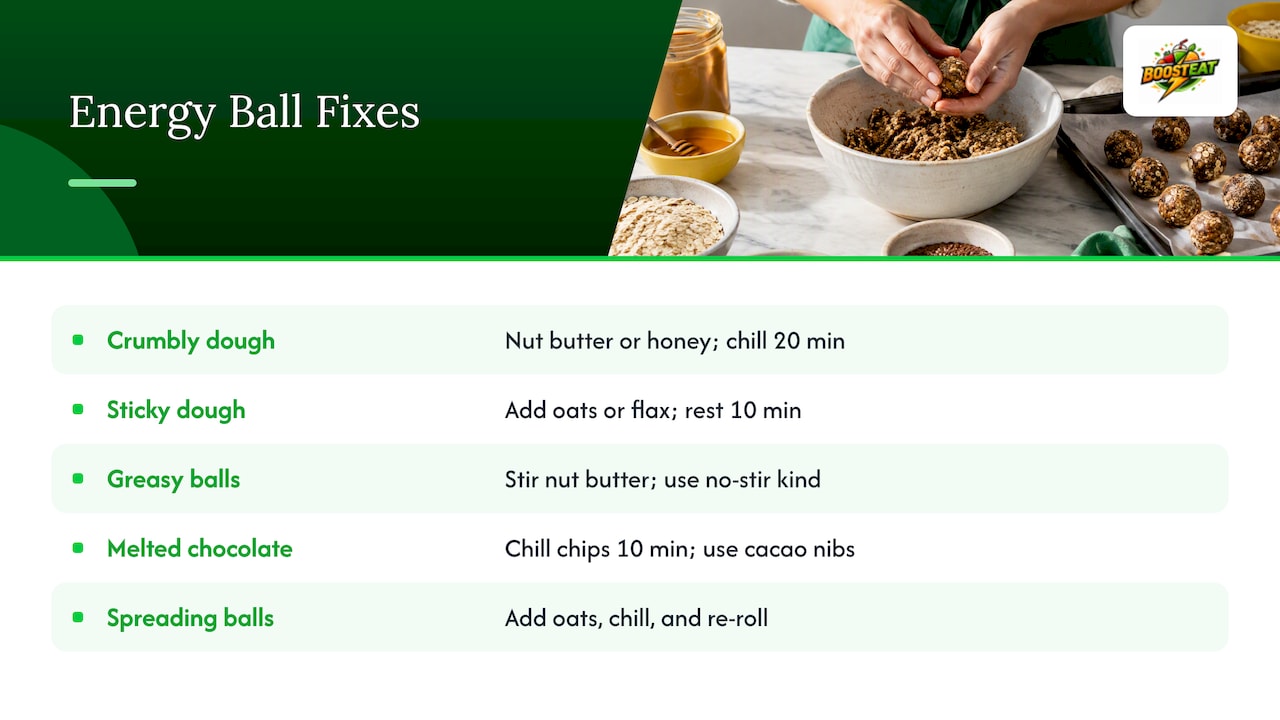
The dough is too crumbly. Add a teaspoon of nut butter or honey and mix again. Chilling for 20 more minutes helps too.
The dough is too sticky. Add a spoonful of oats or ground flax and let it rest for 10 minutes, since flax thickens as it absorbs moisture.
The balls are greasy. Natural nut butters separate. Stir the jar thoroughly before measuring, or use a no-stir nut butter.
The chocolate melted into streaks. Chill the chips for 10 minutes before mixing, or use cacao nibs.
The balls spread when they sit. The dough is too wet. Add oats, chill, and re-roll.
Save your recipes and plan the week
If you like having a stack of reliable snack and breakfast recipes in one place, our Member’s Kitchen is available at 7 EUR per month or 70 EUR per year. You can also browse free recipes, from smoothies to Greek dishes, on the Boost Eat homepage.
FAQ
What is the best recipe for energy balls?
The best recipe is one you will make again. A good starting point is 1 cup rolled oats, 1/2 cup nut or seed butter, 1/3 cup honey or maple syrup and 1/2 cup of boosters such as ground flax and chocolate chips. Adjust the oats or the nut butter by the spoonful until the dough holds together when pressed.
Do energy balls need to be refrigerated?
It is best to refrigerate them. Chilling keeps them firm and helps them last longer, and balls with fresh fruit or soft dates especially should stay cold. Freeze extras if you will not eat them within a week or so.
Can I make energy balls without peanut butter?
Yes. Sunflower seed butter, tahini, almond butter or cashew butter all work as binders. Use seed butter for a nut-free version, and check every label for cross-contamination warnings if you are cooking for someone with an allergy.
Are energy balls good for weight loss?
They can fit into a weight-loss plan as a controlled snack, but they are not low in calories. With roughly 90 to 150 kcal per ball in published recipes, a portion of one or two is plenty. If you have a specific weight or health goal, a registered dietitian can set targets that suit you.
Sources
General Entertainment & Information Purposes Only. At Boost-Eat.com and our partners we share content for general entertainment and information. It’s not medical, dermatological, nutritional, or fitness advice and shouldn’t replace guidance from a licensed professional. If you’re making health-related decisions, please check with a qualified expert — and know that using this site and its information is at your own discretion.
Discover more from BOOST EAT
Subscribe to get the latest posts sent to your email.

