Yes, you can meal prep smoothies, and the method that works best for most people is the freezer pack: portion every solid ingredient into a bag, freeze it, and add liquid and blend on the morning you want it. You can also blend a full batch and freeze or refrigerate it, but each approach has trade-offs in taste, texture and safety. This guide walks through both, with a formula, a Sunday prep routine, storage rules and flavor ideas.
Key takeaways
Two approaches work: freeze the finished smoothie and thaw it overnight in the fridge, or freeze the raw ingredients in portions and blend when you are ready (Cleveland Clinic).
Freezer packs give the best texture because you blend fresh each morning. Add the liquid at blending time, not in the bag.
Perishable food should not sit out for more than 2 hours, or 1 hour above 90°F, according to the FDA. Refrigerated leftovers are best used within four days.
A repeatable formula (greens, fruit, protein, fat, liquid) lets you prep a week of different smoothies in about 30 minutes.
Table of Contents
Can you meal prep smoothies?
You can, and it is one of the easier breakfasts to prepare ahead. A smoothie is mostly fruit, vegetables, a creamy base and a liquid, and almost all of those freeze well. The trick is deciding what to do ahead and what to leave until the morning.
There are three practical ways to do it:
Freezer packs. Portion the solid ingredients into bags or containers and freeze. In the morning, add liquid and blend.
Frozen finished smoothies. Blend a batch, pour it into jars or containers, freeze, and thaw in the fridge overnight. Cleveland Clinic describes both this and the portioned-ingredient approach in its meal prep ideas.
Short-term fridge batches. Blend a few servings and refrigerate them for the next day or two. This is the quickest, but it gives the least consistent texture.
If you only try one, make it the first. It takes the same effort as the others, keeps the longest, and tastes the freshest.
Why freezer packs beat blending the whole week at once
A smoothie blended on Sunday and kept in the fridge will separate, darken and lose its bright flavor by midweek. Fruit oxidizes, fiber settles, and anything with greens can turn a duller shade. Freezing the raw ingredients pauses all of that.
Freezer packs also solve three common problems:
Texture. Frozen fruit does the job of ice, so the smoothie comes out thick and cold without being watered down.
Flexibility. Because the liquid is added later, you can choose dairy milk, a plant milk, water or coconut water depending on the day.
Storage space. Flat bags stack neatly in a freezer drawer, while jars take up far more room.
The main downside is that you need a decent blender and a minute or two of blending time. If your blender struggles, let the pack sit on the counter for a few minutes first. One recipe that uses this method suggests removing the bag 5 to 10 minutes before blending, breaking up the contents, then adding almond milk and blending until smooth (Del Monte).
A simple formula for any smoothie pack
Rather than following a different recipe each day, use a template. Every pack gets one item from each group below, and you vary the flavors from week to week.
| Component | Role | Examples | Typical amount per pack |
|---|---|---|---|
| Frozen fruit | Sweetness, body, cold | Banana, mango, pineapple, berries | 1 to 1½ cups |
| Greens | Fiber, micronutrients, color | Spinach, kale | 1 large handful |
| Protein or creamy base | Fullness, thickness | Greek yogurt, silken tofu, protein powder, nut butter | ¼ cup or 1 scoop or 1 tbsp |
| Seeds or oats | Fiber, healthy fats | Chia, ground flax, hemp hearts, rolled oats | 1 to 2 tbsp |
| Liquid (added later) | Blending | Milk, plant milk, water | ¾ to 1 cup |
These amounts are starting points, not rules. A larger appetite or a longer morning ahead calls for more protein and oats. A light snack needs less.
What about the 1-2-3 smoothie rule?
The “1-2-3” formula you may see online comes in several versions. The one published by Montana State University Extension, “Easy as 1, 2, 3 Smoothie,” is a batch ratio: 2 cups of fresh greens, 4 cups of cold water and 6 cups of fruit, added to the blender in that order and blended until smooth (Montana State University Extension). That makes a large amount, so it suits a family or a few days of fridge prep better than a single serving. For one person, scale it down proportionally, or use the table above, which builds in protein and fat as well.
How to prep a week of smoothies in 30 minutes
This is the routine we suggest for a busy week. Set aside one short session, ideally on the weekend.
Step 1: Pick two or three flavors, not seven
Variety matters, but making seven different packs slows you down. Choose two or three combinations and make several of each. You will still feel like you are eating different things.
Step 2: Wash, chop and dry
Wash greens and spin them dry, since wet leaves create ice crystals. Peel and slice bananas, and cut larger fruit into chunks about an inch across so the blender can handle them. If you are chopping a lot of ingredients, a small mini food processor can speed up the work of cutting greens, nuts or dates into small pieces.
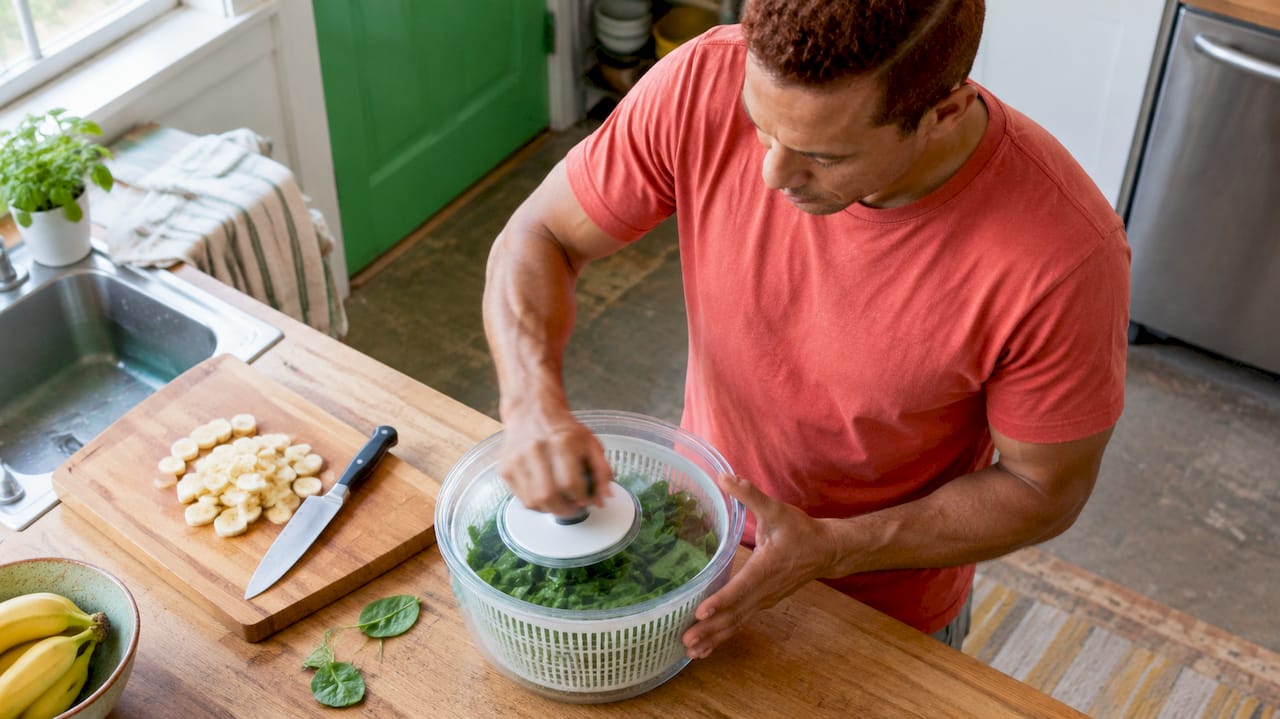
Step 3: Set up an assembly line
Label your freezer bags first, with the flavor and the date. Then line them up and add ingredients one group at a time: fruit into every bag, then greens, then seeds and oats, then any nut butter or yogurt. Working group by group is faster than building one bag at a time.
One recipe for freezer packs advises labeling quart-size bags, adding everything except the liquid, pressing out excess air and sealing (Del Monte). Removing the air limits freezer burn, which dries out fruit and dulls its flavor.
Step 4: Freeze flat
Lay the bags flat on a tray so they freeze into slabs. Once solid, stack them upright like files. Flat packs thaw faster and break apart more easily.
Step 5: Blend in the morning
Take out a pack a few minutes ahead, tip it into the blender, add your liquid, and blend until smooth. Start with less liquid than you think you need and add more if the blades stall. You can always thin a smoothie, but you cannot thicken one without more frozen fruit.
Four flavor combinations to start with
Each of these is one pack. Add about a cup of liquid when you blend.
Green tropical
Mango chunks, pineapple, a handful of spinach, 1 tablespoon hemp hearts. Cleveland Clinic notes that its cool tropical smoothies are dairy-free and vegan, made by adding a milk substitute and blending (Cleveland Clinic), so this combination fits that pattern.
Berry oat breakfast
Mixed frozen berries, half a frozen banana, ¼ cup rolled oats, 1 tablespoon chia seeds, ¼ cup Greek yogurt or a scoop of protein powder. The oats make this one thick enough to count as a real breakfast.
Peanut butter banana
Two halves of a frozen banana, 1 tablespoon peanut or almond butter, 1 tablespoon ground flax, a few spinach leaves. The spinach disappears into the banana flavor, which makes this a good option for kids who avoid greens.
Mocha without the crash
Frozen banana, 1 tablespoon cacao powder, 1 tablespoon nut butter, ¼ cup oats. Blend with cold brewed coffee in place of milk if you want a caffeine boost, or with a plant milk if you do not. For mornings when you would rather skip caffeine altogether, there are plenty of caffeine-free coffee alternatives that work as a warm drink on the side.
Making your packs vegan, gluten-free or lower in sugar
Smoothie packs adapt easily because the formula is flexible.
Vegan and dairy-free: Swap Greek yogurt for silken tofu, coconut yogurt or a spoonful of nut butter, and blend with oat, almond, soy or coconut milk.
Gluten-free: Smoothies are naturally gluten-free until you add oats. Use oats labeled gluten-free, or replace them with extra chia, ground flax or half a banana.
Lower sugar: Lean on berries, which tend to be lower in sugar than tropical fruit, use only half a banana, and add greens, avocado or plain yogurt for body instead of juice. Avoid juice as a liquid; water or unsweetened milk keeps the added sugar down.
Child-friendly: Keep flavors familiar (banana, strawberry, a little peanut butter), blend very smooth, and serve in a small cup with a straw. If your child has a nut allergy, use sunflower seed butter in place of nut butter.
If you like the idea of frozen, sugar-conscious treats, our frozen yogurt bark uses many of the same ingredients and is a good use for leftover berries.
Storage and food safety
This is where meal prep can go wrong, so it is worth being precise.
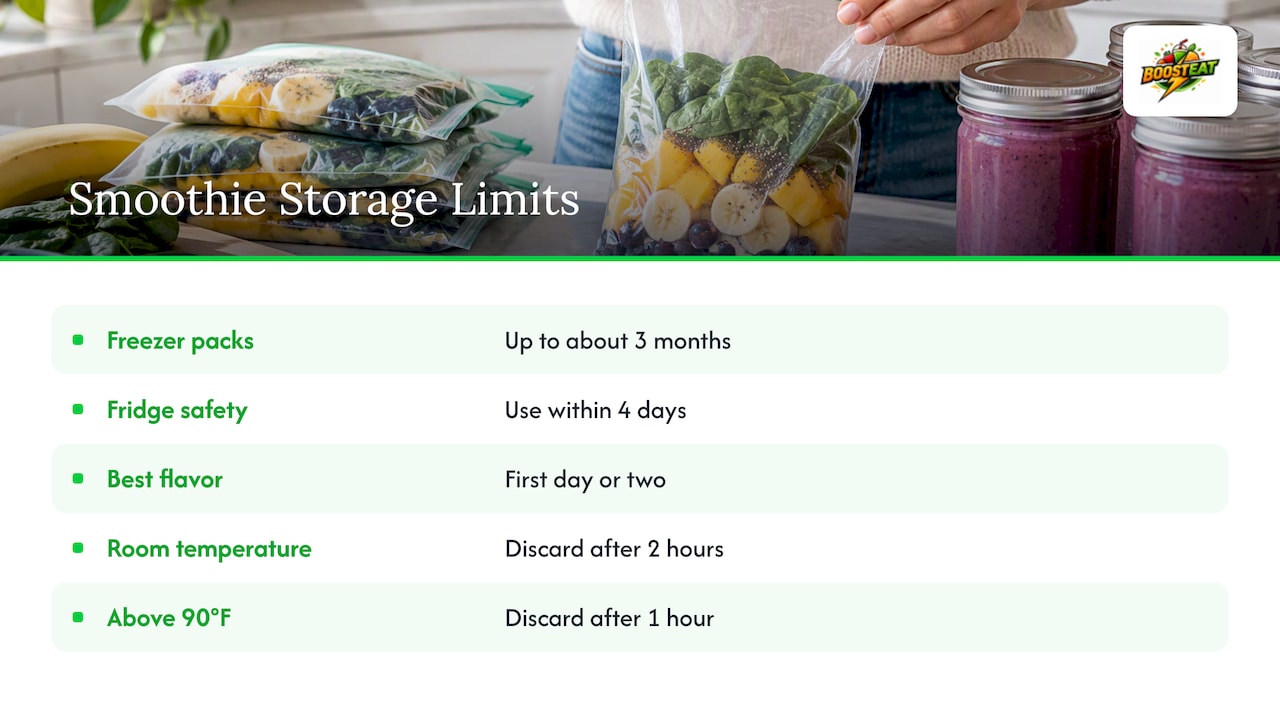
Freezer packs. Recipes that use this method typically suggest freezing for up to about 3 months (Del Monte). Past that point they are not unsafe, but fruit loses flavor and picks up freezer taste. A weekly prep session means you will never come near that limit.
Blended smoothies in the fridge. Food safety guidance for leftovers says to use them within four days of refrigeration (K-State Research and Extension). That is an outer limit for safety, not a quality guarantee. A smoothie made with dairy, yogurt or protein powder is a perishable food, and in our experience the flavor and texture are best in the first day or two. If you want more than that, freeze it.
Smoothies out of the fridge. Perishable food that has been left at room temperature should be thrown away after 2 hours, or after 1 hour if the temperature is above 90°F (FDA). That matters for a smoothie in a gym bag, a school lunchbox or a hot car. Use an insulated bottle with a frozen ice pack, and do not keep refilling the same cup throughout the day.
Do not rely on taste or smell. Harmful bacteria do not always change how food tastes or smells, and K-State Extension advises never tasting a leftover you suspect has spoiled (K-State Research and Extension). If you are unsure how long a smoothie has been sitting, throw it out. This applies especially to young children, pregnant women, older adults and anyone with a weakened immune system, who are more vulnerable to foodborne illness and should be extra cautious with any dairy-based drink that has been stored.
Thawing frozen finished smoothies. Thaw in the refrigerator overnight rather than on the counter, then shake or stir before drinking, since separation is normal.
Quick storage reference
| Method | Where | Best within | Best for |
|---|---|---|---|
| Freezer pack (raw ingredients) | Freezer | Up to about 3 months | Weekday breakfasts |
| Frozen blended smoothie | Freezer, thaw in fridge | A few weeks for best flavor | Grab-and-go jars |
| Blended smoothie | Refrigerator | 1 to 2 days for quality, 4 days as a hard limit | Next-day convenience |
| Smoothie out of the fridge | Room temperature | 2 hours, or 1 hour above 90°F | Never longer |
The “few weeks” figure for frozen blended smoothies is our own practical guideline for flavor, not a regulatory limit.
How to keep taste and texture good all week
The most common complaints about prepped smoothies are that they turn icy, watery or brown. A few habits prevent all three.
Use ripe bananas. Peel and slice them before freezing. Underripe ones taste starchy and bland once frozen.
Pair your greens with strong flavors. Spinach is mild enough to hide behind banana, mango or berries. Kale is stronger and benefits from pineapple or a little lemon.
Add fat or protein. Nut butter, avocado, yogurt or tofu make the texture creamy and stop the smoothie from feeling thin.
Add a pinch of salt or a squeeze of citrus if the flavor tastes flat. It lifts the fruit the way it does in cooking.
Blend longer than you think. A full minute produces a smoother, less gritty result, especially with seeds and oats.
Drink promptly. A smoothie is at its best straight out of the blender.
A whole-food approach helps here too. Registered dietitian Constance Weissmuller points to ingredients like nuts, seeds and oats as a way to get protein, fiber and healthy fats together, rather than relying only on protein isolates (JOVA). That advice fits neatly into a freezer pack, where seeds and oats are easy to add and keep well.
Our perspective: keep it boring, then make it yours
We write a lot of smoothie recipes at Boost Eat, and the pattern we see is that people give up on smoothie routines for one of two reasons: it takes too long, or it gets repetitive. Meal prep fixes the first. A flexible formula fixes the second.
Our advice is to start small. Make four packs of one combination you already like, try them for a week, and notice what bothers you. Too thick? Add more liquid. Too sweet? Cut the banana. Hungry by 10 a.m.? Add oats or protein. Once the base works, you can build outward into vegan, gluten-free or sugar-free versions, and into snacks and desserts that use the same ingredients.
We also think smoothies should support a balanced diet, not replace one. A well-built smoothie with fruit, greens, protein and fat is a solid breakfast or snack. A large glass of fruit and juice with nothing else is mostly sugar. The formula above is designed to keep you on the first side of that line.
— Simos
Save your favorite prep recipes
If you want to keep your best smoothie combinations, weekly prep lists and family-friendly ideas in one place, you can join Boost Eat Member’s Kitchen for €7 per month or €70 per year. You can also browse free recipes on the Boost Eat homepage, from Greek yogurt ideas to sugar-free jam that goes well swirled into a yogurt-based smoothie bowl.
FAQ
Can smoothies be meal prepped?
Yes. You can freeze a finished smoothie and thaw it in the fridge overnight, or portion the ingredients and freeze them until it is time to blend (Cleveland Clinic). Freezer packs generally taste fresher because the blending happens on the day you drink it.
How long do prepped smoothies last in the fridge?
For safety, refrigerated leftovers should be used within four days (K-State Research and Extension). For flavor and texture, one to two days is better, and anything that has sat out for more than 2 hours should be discarded. If you want to prep further ahead, freeze it.
Should I put the liquid in the freezer bag?
We recommend not to. Adding liquid ahead turns the pack into a solid block that is hard to blend and harder to adjust. Keep the liquid in the fridge and add it when you blend, as most freezer pack recipes do.
What is the 1-2-3 smoothie rule?
It is a loose ratio, and versions vary. Montana State University Extension’s version uses 2 cups of greens, 4 cups of water and 6 cups of fruit for a large batch (Montana State University Extension). It is a handy starting point, but add protein and a healthy fat if you want it to work as a meal.
Sources
Meal Prep Ideas for Breakfast, Lunch and Dinner, Cleveland Clinic
Easy as 1, 2, 3 Smoothie, Montana State University Extension
Recommended
General Entertainment & Information Purposes Only. At Boost-Eat.com and our partners we share content for general entertainment and information. It’s not medical, dermatological, nutritional, or fitness advice and shouldn’t replace guidance from a licensed professional. If you’re making health-related decisions, please check with a qualified expert — and know that using this site and its information is at your own discretion.
Discover more from BOOST EAT
Subscribe to get the latest posts sent to your email.

