
Overnight oats are rolled oats soaked in cold liquid in the refrigerator until they turn soft and creamy, with no cooking. The base recipe is simple: equal parts oats and milk, a spoonful of chia seeds, a little sweetener, and at least four hours in the fridge. Everything else on this page, from high protein and chocolate versions to oats without yogurt, is a variation on that formula.
Key takeaways
- Start with a 1:1 ratio of rolled oats to milk by volume, then adjust thickness with a splash more liquid or a spoonful more chia.
- Always refrigerate the jar. Leaving the mixture at room temperature overnight raises the risk of Bacillus cereus, whose toxins survive reheating.
- Add fresh fruit right before eating, and prepare only two to three days of jars at a time.
- Yogurt is optional. Milk, a plant drink, chia and nut butter all give a creamy result.
- If you follow a strict gluten-free diet, buy oats that are specifically labeled gluten-free.
Table of Contents
- The base recipe
- Which oats to use
- Why soaking works: what the research says
- High protein overnight oats
- Chocolate overnight oats
- Overnight oats without yogurt
- Healthy overnight oats: what to add and what to skip
- Food safety and storage
- Do overnight oats need to be overnight?
- What not to add
- Fiber, digestion and gluten
- Our perspective
- Plan your week of jars
- Frequently asked questions
- Sources
The base recipe
This makes one jar and takes about five minutes. Use a 16-ounce mason jar or any container with a lid.
Ingredients
- 1/2 cup old-fashioned (rolled) oats
- 1/2 cup milk of your choice (dairy, soy, oat or almond)
- 1 tablespoon chia seeds
- 1 to 2 teaspoons maple syrup or honey
- 1/2 teaspoon vanilla extract
- A pinch of salt
Method
- Add the oats, chia seeds and salt to the jar.
- Pour in the milk, then add the vanilla and sweetener.
- Stir well, scraping the bottom so no dry oats stay stuck in the corners.
- Cover and refrigerate for at least four hours, or up to 24 hours for the best texture.
- Stir again in the morning. If it is too thick, add a splash of milk. If it is too loose, wait ten minutes for the chia to take up more liquid.
- Add your toppings and eat it cold or warm it for a minute in the microwave.
The ranking recipes share this same skeleton: oats, liquid, a thickener like chia, and a sweetener. Serious Eats recommends liquid sweeteners such as maple syrup, honey or agave over granulated sugar, because sugar does not dissolve well in cold milk.
Which oats to use
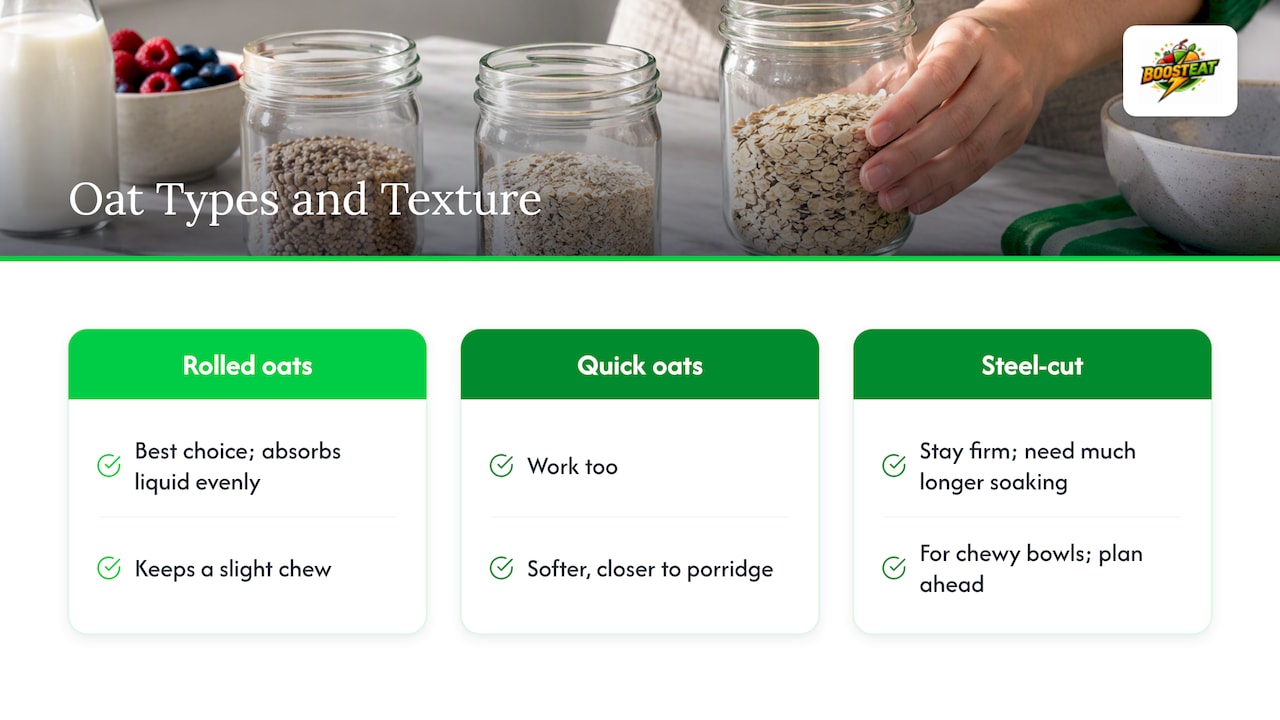
Rolled oats (often labeled old-fashioned) are the best choice. They absorb liquid evenly and keep a slight chew. Quick oats work too, but the result is softer and closer to porridge. Steel-cut oats stay firm and need much longer soaking, so they suit people who like a chewy bowl and plan well ahead.
Why soaking works: what the research says
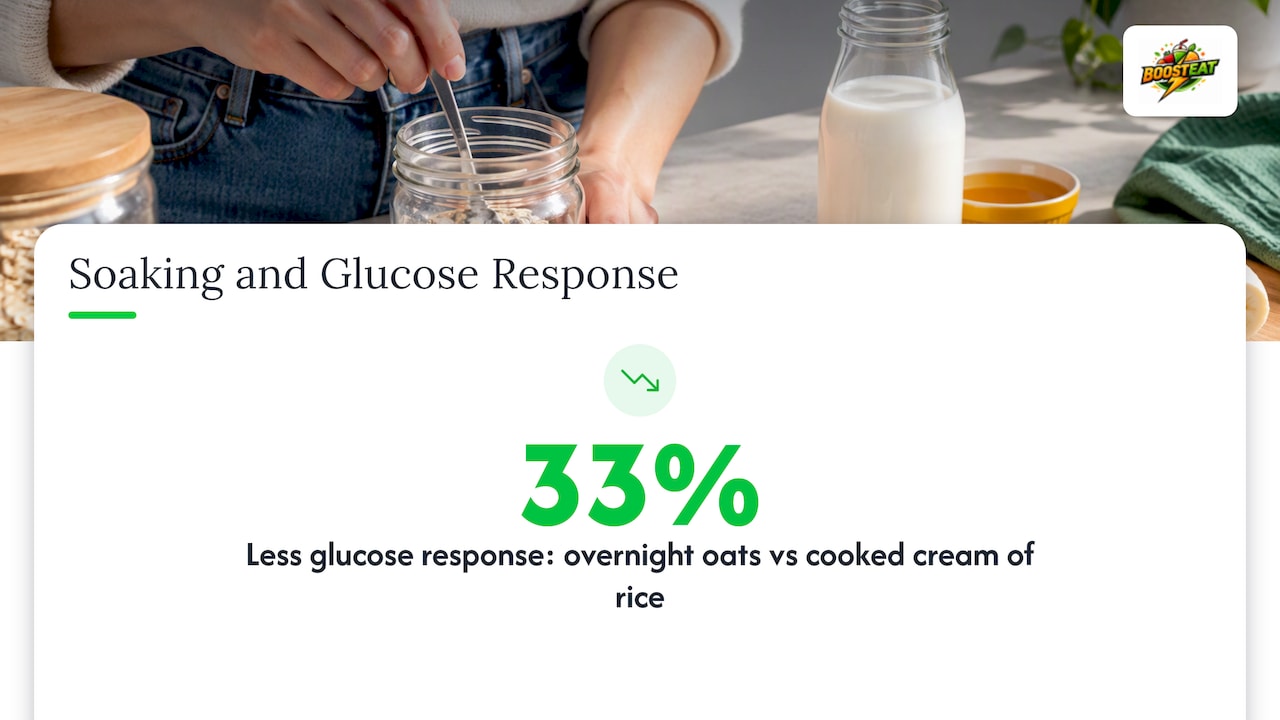
Soaking is not only convenient. In a randomized controlled trial, oats soaked overnight in milk kept their low glycemic and insulinemic impact, producing 33% less glucose response than a cooked cream of rice cereal. The benefit is tied to beta-glucans, a soluble fiber in oats. They thicken the contents of the gut and slow carbohydrate absorption, which blunts the rise in blood sugar after a meal.
A second paper on oat beta-glucan viscosity suggests that avoiding high-heat cooking may help preserve the physiological effect of those fibers. That does not make cooked oatmeal a poor choice. It does mean a jar of cold oats is a perfectly good way to eat them.
One point to keep in mind: toppings change the picture. The same trial looked at oats with and without sugar, nuts and seeds, so a bowl loaded with sweetened yogurt and dried fruit will not behave like a plain one. If you manage blood sugar, keep added sugars modest and favor nuts, seeds and fresh fruit.
High protein overnight oats
Protein overnight oats are the most searched variation, and for good reason. Oats alone are more carbohydrate than protein, so a jar that keeps you full until lunch needs help. Here are the easy levers:
- Greek yogurt: replace a third to half of the milk with plain Greek yogurt. It thickens the oats and adds protein.
- Protein powder: stir in one scoop, and add an extra 2 to 3 tablespoons of milk, because powder absorbs liquid.
- Soy milk: it usually contains more protein than most other plant drinks. Check the label of your brand.
- Nut butter, seeds and nuts: a tablespoon of peanut or almond butter, plus hemp or pumpkin seeds, builds flavor and staying power.
- Cottage cheese or silken tofu: blended into the milk first, they disappear into the texture.
Exact protein totals vary widely by brand, so read the nutrition panels on your yogurt, milk and powder and add them up for your own jar.
A simple high protein jar
1/2 cup rolled oats, 1/2 cup soy milk, 1/4 cup plain Greek yogurt, 1 scoop vanilla protein powder, 1 tablespoon chia seeds and a pinch of cinnamon. Mix, chill, and top with berries in the morning. If you like Greek yogurt in your kitchen, our Greek yogurt dessert ideas show what else to do with a tub.
Chocolate overnight oats
Chocolate is the flavor kids and adults ask for most. The trick is to use unsweetened cocoa powder, which mixes more cleanly than chocolate chips and keeps sugar under your control.
For one jar: 1/2 cup rolled oats, 1/2 cup milk, 1 tablespoon unsweetened cocoa powder, 1 tablespoon chia seeds, 1 to 2 teaspoons maple syrup, a pinch of salt and 1/2 teaspoon vanilla.
Whisk the cocoa into the milk first so it does not clump, then stir in the oats. Good additions:
- A tablespoon of peanut butter for a chocolate peanut butter version
- Sliced banana added in the morning
- A few dark chocolate shavings on top
- A spoonful of raspberries, whose tartness balances the cocoa
For children, keep the sweetener low and let the banana do the work. Most kids accept the flavor with less sugar than you would expect.
Overnight oats without yogurt
Yogurt is a convenience, not a requirement. Plenty of people skip it because of a dairy allergy, a vegan diet or simple taste. Without yogurt, the oats are looser, so lean on these:
- Chia seeds: use 1 to 2 tablespoons per jar. They form a gel that gives body.
- A mashed banana: it sweetens and thickens at once.
- Nut butter: peanut, almond or sunflower seed butter adds creaminess.
- Less liquid: drop the milk to a little under 1/2 cup per 1/2 cup oats if you like a spoonable texture.
- Coconut milk: a few tablespoons from the can make it rich.
A vegan jar can be as simple as oats, soy or oat milk, chia, maple syrup and cinnamon, topped with fruit. Check that your oat milk and other ingredients carry the labels your diet requires.
Healthy overnight oats: what to add and what to skip
Overnight oats can be a balanced breakfast when you build them with plain oats, an unsweetened liquid and nutrient-dense toppings, as Acibadem Hospitals Group notes. The problem usually starts with the extras. Sweetened flavored yogurt, a heavy pour of syrup and large handfuls of dried fruit can turn a smart breakfast into a dessert. Serious Eats suggests avoiding high-sugar additions like flavored yogurts and excessive dried fruit.
A balanced jar usually has four parts:
- Whole grain: the oats
- Protein: milk, yogurt, powder or nut butter
- Healthy fat and fiber: chia, flax, nuts or seeds
- Fruit: fresh or frozen berries, apple, banana or peaches
For sweetness, ripe fruit and cinnamon go a long way. If you want a fruity swirl without added sugar, try our sugar-free chia jam as a topping.
Topping timing
Stir flavorings and non-perishable toppings such as seeds, nuts and spices into the jar, or add them right before eating. Sliced bananas, apples and fresh berries are best added just before serving, because they brown, soften and turn soggy if they sit. Actually, the safer source for that claim is the food-quality guidance from Serious Eats, which recommends topping with fresh fruit just before serving, so follow that rule and keep your jar tidy.
Food safety and storage
This is the part many recipe pages skip. Overnight oats are a raw oat dish, and they must go into the refrigerator. According to North Carolina Cooperative Extension, leaving the mixture out overnight creates a high risk of Bacillus cereus growth, and the toxins it makes are not destroyed by later heating. The Ohio State extension fact sheet also notes that raw oat dishes call for different safety thinking than cooked ones.
Practical rules:
- Refrigerate the jar right after mixing.
- Keep it covered.
- Prepare two to three days of jars at a time. They may last up to five days, but texture and quality fall off after 48 to 72 hours, especially with fresh fruit.
- Do not take a jar on a long unrefrigerated trip. Use an insulated bag with an ice pack.
Do overnight oats need to be overnight?
Not strictly. Four hours is enough for a creamy bowl, and many people find two hours gives a softer-but-chewier result. Overnight is simply the most convenient window, because you mix the jar at 9 p.m. and eat it at 7 a.m. Keeping it in the fridge for up to 24 hours gives the best texture.
If you forget, you can stir the oats with warm milk and wait 15 minutes. That is not the same as cold soaking, but it works in a pinch.
What not to add
- Granulated sugar: it stays gritty in cold milk. Use liquid sweeteners.
- Cut fruit for several days: it softens and browns. Add it fresh.
- Large amounts of dried fruit or flavored yogurt: the sugar adds up quickly.
- Too much liquid: the oats turn soupy. Start at 1:1.
- Raw eggs or anything perishable left unrefrigerated: keep everything cold.
Fiber, digestion and gluten
Oats are a rich source of fiber, but they are not right for everyone at every portion. If you are not used to a high-fiber diet, you may feel temporary bloating. Start with a smaller jar, drink enough water, and increase gradually. If symptoms persist, see your doctor or a registered dietitian.
Gluten deserves clear words. Oats are naturally gluten-free, but they are at high risk of cross-contamination with wheat, rye or barley during harvest and processing. For people with celiac disease, only oats labeled gluten-free, meeting strict testing standards such as under 20 ppm, are considered safe. The Dietitians in Gluten and Gastrointestinal Disorders workgroup also advises that guidance on oats for each patient should come from a clinician. Rules differ by country: under the Australian Food Standards Code, no type of oat can be called gluten-free.
If you suspect gluten is behind your symptoms but have not been diagnosed, read about the signs of gluten intolerance and talk to a gastroenterologist before cutting out foods on your own.
Our perspective
We built Boost Eat around one idea: healthy food should be easy enough that you actually make it. Overnight oats are a great example. They cost almost nothing, they take five minutes, and they adapt to nearly every diet we cook for, from vegan and gluten-free to low-calorie and sugar-free.
Our advice is to stop treating the recipe as fixed. Learn the 1:1 base, keep a short list of go-to add-ins, and change the flavor weekly. For families, let children pick the toppings, because a jar they helped build gets eaten. And watch the sugar: the jar is only as healthy as what you put on top.
— Simos
Plan your week of jars
If you want more ideas without rethinking breakfast each Sunday, our Member’s Kitchen is €7 per month or €70 per year. You can also browse free recipes on the Boost Eat homepage, from smoothies to Greek dishes and healthy snacks.
Frequently asked questions
What are the ingredients for plain overnight oats?
You need rolled oats, milk or a plant-based drink, and a pinch of salt. Most people also add chia seeds, a little maple syrup or honey, and vanilla. Use equal parts oats and milk, then adjust to taste.
How long do overnight oats last in the fridge?
They can last up to five days when kept cold, but two to three days gives the best texture and quality. Add fresh fruit only when you are ready to eat. Never leave the jar out at room temperature overnight.
Can I eat overnight oats warm?
Yes. Warm them in the microwave for 60 to 90 seconds, stirring halfway, and add a splash of milk. They taste more like traditional oatmeal. Add fresh fruit after heating.
Are overnight oats gluten-free?
Only if you buy oats labeled gluten-free. Plain oats are often cross-contaminated with wheat, rye or barley. If you have celiac disease, check labels and ask your doctor or dietitian about oats.
Sources
- Glycaemic and insulinaemic impact of oats soaked overnight in milk (randomized controlled trial)
- Oat beta-glucan viscosity and processing
- Overnight Oatmeal Safety, N.C. Cooperative Extension
- Raw Oat Safety, CFAES Knowledge Hub
- Easy overnight oats recipe, Serious Eats
- Overnight Oats: The Ultimate Healthy Breakfast, Attend Urgent Care
- Food labelling guidelines for celiac disease, Canadian Celiac Association
- Oats, Avenin and Coeliac Disease, Coeliac Australia
Recommended
- Delicious Greek Yogurt Dessert Ideas You Can Whip Up Fast
- Make Sugar-Free Jam: Easy Chia Seed & Pectin Methods
General Entertainment & Information Purposes Only. At Boost-Eat.com and our partners we share content for general entertainment and information. It’s not medical, dermatological, nutritional, or fitness advice and shouldn’t replace guidance from a licensed professional. If you’re making health-related decisions, please check with a qualified expert — and know that using this site and its information is at your own discretion.
Discover more from BOOST EAT
Subscribe to get the latest posts sent to your email.

