
Gemista (also spelled yemista) is the Greek way of stuffing summer vegetables, usually tomatoes and peppers, with a filling of rice, herbs and olive oil, then baking them with potatoes until the juices turn into a rich sauce. The version below is the classic vegetarian one, which is how most Greek households cook it in summer. It takes about 30 minutes of prep and about an hour in the oven, and it tastes better the next day.
Key takeaways
- Gemista means “stuffed” in Greek. The classic version is vegetarian: tomatoes and peppers filled with rice, herbs, onion and plenty of olive oil.
- The rice goes in partly cooked and finishes inside the vegetables, soaking up the tomato pulp and olive oil as it bakes.
- Ripe, firm summer tomatoes and potatoes tucked between the vegetables make the dish. Do not skip the potatoes.
- Gemista keeps well, reheats gently and is naturally vegan and dairy-free, so it suits a lot of tables.
- Meat is optional. Ground beef or pork is a common variation, but the olive oil and herb version is the one most people mean by “authentic.”
Table of Contents
- What gemista is
- Ingredients for gemista
- How to make gemista, step by step
- Oven temperature and how to tell they are done
- Greek stuffed peppers and tomatoes: vegetarian, vegan and meat versions
- What to serve with gemista
- Are gemista healthy?
- Storing and reheating leftovers
- Our perspective on gemista
- Get more recipes like this
- FAQ
- Sources
What gemista is
The word comes from the Greek for “filled.” Gemista are vegetables hollowed out and stuffed, then baked slowly in the oven. Tomatoes and bell peppers are the stars, and zucchini and eggplant often join them. Visit Greece’s recipe lists tomatoes, peppers and zucchini, filled with a rice-and-dill mixture built from the scooped-out tomato pulp, onion, garlic, olive oil, salt, pepper and a pinch of sugar. Potatoes are arranged around the vegetables, and feta and bread are suggested for serving.
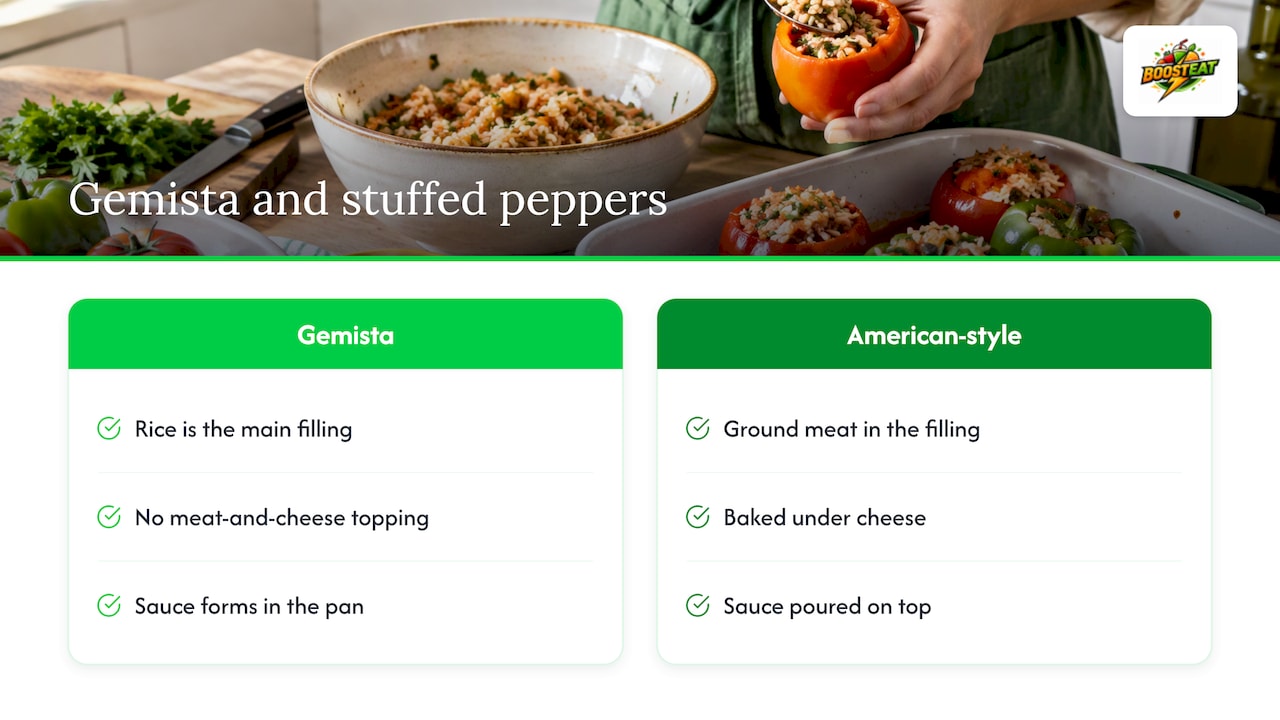
Two things set gemista apart from the stuffed peppers many Americans grew up with. First, the rice is the main filling and is not mixed with a pound of ground meat and baked under cheese. Second, the sauce is not poured over the top. It forms in the pan from the vegetables’ own juices and the olive oil.
You will see “gemista,” “yemista” and “gemista” with different spellings on menus. They are the same dish. In Greece it is a home-cooking staple of summer, eaten warm or at room temperature, often with a block of feta on the side.
Ingredients for gemista
This makes about 6 servings and follows the pattern of the traditional recipes. An ingredients sheet from the American School of Classical Studies at Athens for a 5 to 6 serving batch lists tomatoes, green and red peppers, onion, garlic, parsley, mint, 350 g of rice, extra-virgin olive oil, carrot, salt, pepper, sugar, tomato paste and potatoes, with zucchini and eggplant as optional extras. Our home version stays close to that.
The vegetables
- 6 large, ripe but firm tomatoes
- 4 bell peppers, any color (red and yellow are sweeter, green is more traditional)
- 2 medium zucchini, optional
- 1 pound of small potatoes, peeled and cut into wedges
The filling
- 1 3/4 cups (about 350 g) medium or long grain white rice, uncooked
- 2 large onions, finely chopped
- 3 cloves of garlic, minced
- 1 grated carrot, optional
- A large handful each of fresh parsley, mint and dill, chopped
- 1/2 cup extra-virgin olive oil, plus more for drizzling
- 1 tablespoon tomato paste
- 1 teaspoon sugar
- Salt and black pepper
- The scooped-out tomato pulp
You will also need a deep baking dish that fits the vegetables snugly. If they have room to wobble, they tip over and the filling dries out.
Choosing the vegetables
Pick tomatoes and peppers of similar size so they cook at the same pace. Tomatoes should be ripe for flavor but still firm so they do not collapse. Peppers should sit upright on their own. Cut a thin slice off the bottom if one wobbles, but do not cut through.
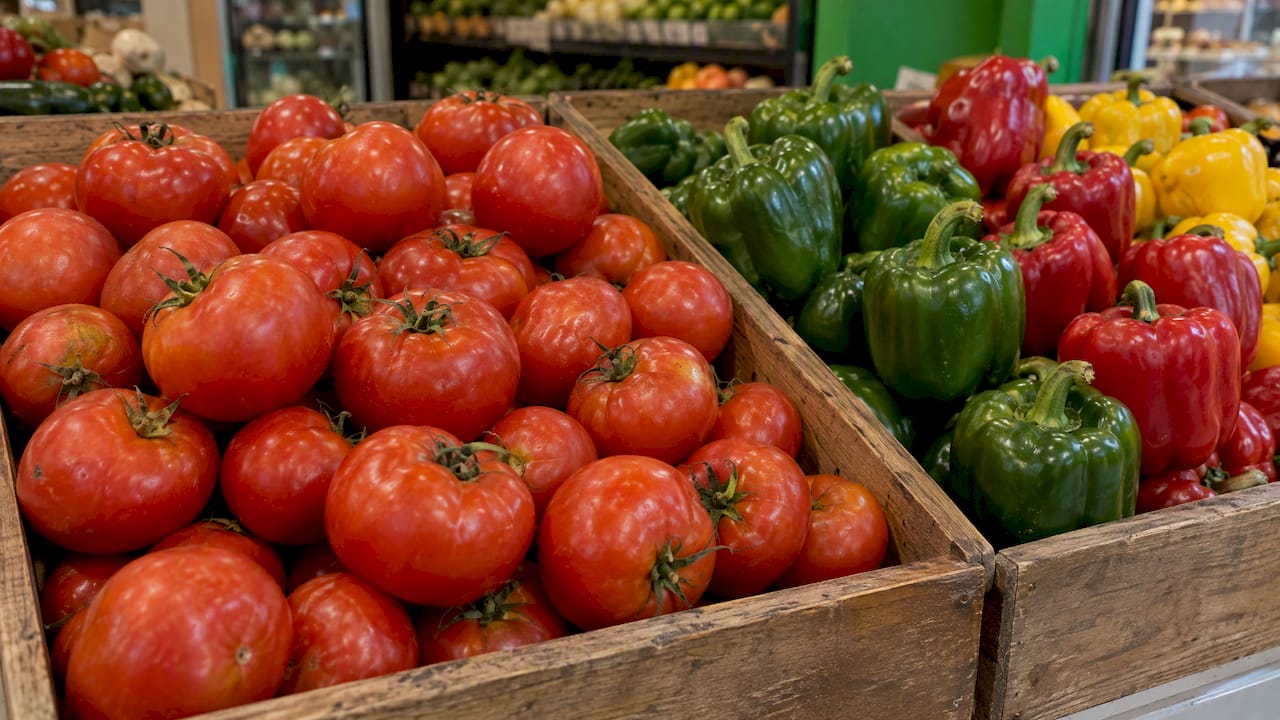
Out-of-season supermarket tomatoes can be watery and bland. If that is what you have, add a spoonful of tomato paste and an extra pinch of sugar to the filling, and expect to bake a few minutes longer to evaporate the liquid.
How to make gemista, step by step
- Prep the vegetables. Heat the oven. Cut a slice off the top of each tomato, pepper and zucchini and keep these “lids.” Scoop out the tomato pulp with a spoon into a bowl, being careful not to pierce the walls. Remove seeds and ribs from the peppers. Hollow the zucchini, and chop and add that flesh to the pulp bowl if you like.
- Season the shells. Sprinkle a little salt and sugar inside each vegetable. This draws out flavor and balances any acidity in the tomatoes.
- Cook the base. Warm some of the olive oil in a wide pan. Cook the onions and garlic until soft and golden, about 8 to 10 minutes. Add the carrot if using.
- Add the pulp. Crush or blend the tomato pulp, pour it into the pan with the tomato paste, and simmer a few minutes. This is the foundation of the sauce.
- Add the rice and herbs. Stir in the rice and cook it briefly, then add the chopped herbs. The Visit Greece method covers the pan and cooks until the rice is half-cooked, which is what you want. The rice finishes inside the vegetables.
- Season. Add salt, pepper and the sugar. Taste the liquid: it should be a little saltier than you would like, because the rice and vegetables will dilute it.
- Fill. Spoon the filling into each vegetable, only about three-quarters full. The rice will swell. Put the lids back on.
- Arrange. Stand the vegetables upright in the baking dish, packed closely. Tuck the potato wedges into the gaps. Pour a little water (about a cup) around them, add the remaining olive oil, and drizzle a little over the tops too.
- Bake. Bake until the vegetables are tender, the tops are lightly browned and the rice is fully cooked. Plan on roughly an hour, and check at the 40-minute mark.
- Rest. Let the dish stand for at least 15 minutes before serving. The juices settle and the flavor deepens.
Oven temperature and how to tell they are done
The Visit Greece recipe bakes at 180°C fan, which is around 350°F in a standard American oven. Many Greek home cooks start hotter to get color on the vegetables and then lower the heat or cover the dish. Either approach works. What matters is how the dish looks, not the exact number.
Your gemista are done when:
- A knife slides into the tomato walls and the pepper skin with no resistance.
- The tops of the vegetables are browned at the edges and the potatoes are golden and soft.
- You press a grain of rice from the filling and it is tender all the way through.
- The liquid in the pan has reduced to mostly olive oil and thickened juices.
If the tops brown before the rice is cooked, cover the dish loosely with foil and keep baking. If there is still a lot of watery liquid in the pan at the end, bake it uncovered for another 10 minutes.
Common problems
| Problem | Likely cause | Fix |
|---|---|---|
| Rice is crunchy | Filling packed too full, or not enough liquid | Fill only three-quarters; add a little hot water to the pan and bake covered |
| Tomatoes collapse | Overripe or walls scooped too thin | Choose firmer tomatoes; leave about 1/4 inch of wall |
| Filling is bland | Too little salt or herbs | Season the cooking liquid boldly; add more fresh herbs |
| Peppers burn on top | Dish uncovered the whole time | Cover with foil for the middle of the bake |
| Sauce is watery | Very juicy tomatoes | Bake uncovered for the last 10 to 15 minutes |
Greek stuffed peppers and tomatoes: vegetarian, vegan and meat versions
The classic recipe above is already vegetarian and, with no cheese or egg in it, vegan. The feta on the side is the only dairy, and you can skip it.
If you want to change the filling, here are the common routes:
- Add pine nuts and raisins. A few tablespoons of each give a sweet, nutty note that is very traditional in some regions.
- Use more vegetables. Grated zucchini or finely diced eggplant bulks up the filling without changing the character.
- Add chickpeas or lentils. A cup of cooked chickpeas adds protein and makes the dish more filling as a main course.
- Make it with meat. Many families brown ground beef or pork with the onions before adding rice. Use about half a pound for this quantity and reduce the rice slightly.
- Swap the rice. Brown rice works but needs a longer bake and more liquid. Cook it partly first.
If you cook for a mixed table, stuff most of the vegetables with the vegetarian filling and a few with a meat version, and mark them with different lids, such as a basil leaf tucked under the vegetarian lids.
What to serve with gemista
Gemista is a complete meal because of the potatoes, but a few simple additions round it out:
- A block of feta, as Visit Greece suggests, along with crusty bread for the juices in the pan.
- A simple tomato, cucumber and olive salad.
- A spoonful of thick Greek yogurt, which adds a cool, tangy contrast.
- A light Greek yogurt dessert afterward. If you want ideas, we collected some Greek yogurt dessert ideas that come together quickly.
Gemista is traditionally served warm, not hot. The flavors are clearer once the dish has cooled for a bit, and it is also excellent at room temperature.
Are gemista healthy?
In broad terms, yes, with some caveats. The dish is built on vegetables, olive oil, herbs and rice, which fits the pattern of traditional Mediterranean eating. Tomatoes and peppers bring vitamin C and fiber, and the herbs add flavor without salt or sugar.
What changes the nutritional picture is how you cook it:
- Olive oil. Traditional recipes use a lot, and that is part of the flavor. It also makes the dish calorie-dense. You can cut the amount a little, but do not remove it entirely or the rice turns dry.
- Rice. White rice is the standard. Part brown rice, or adding lentils or chickpeas, raises fiber and protein.
- Meat and cheese. Adding ground meat raises protein but also saturated fat, depending on the cut.
- Portion size. One stuffed tomato and one pepper with a few potatoes is a reasonable plate. Three of each with extra bread is a much heavier meal.
- Salt. Season in stages and taste. Serving with feta adds more sodium.
If you manage a medical condition such as diabetes or kidney disease, ask your dietitian or doctor how to fit rice and potatoes into your meal plan, and how much olive oil suits you.
Storing and reheating leftovers
Gemista is one of those dishes that improves overnight. To keep it safe and tasty:
- Let the dish cool, but do not leave rice-based food sitting out for long. Move it to the refrigerator within about two hours.
- Store the vegetables in an airtight container with some of the pan juices. Keep the dish in the fridge and eat it within about three days.
- To reheat, place the vegetables in a baking dish with a splash of water, cover with foil and warm in a moderate oven until hot throughout. A microwave works for a single serving. Add a teaspoon of water and cover loosely.
- Reheat only once, and make sure the filling is steaming hot in the center.
If you want to prepare ahead, hollow the vegetables and make the filling the day before. Keep them separate in the fridge, then fill and bake the next day.
Our perspective on gemista
At Boost Eat we think gemista shows what simple, wholesome cooking can be. It is built on a short list of ingredients, it is inclusive by default, because the traditional version is vegan, dairy-free and free of added sugar beyond a pinch, and it scales for a family dinner or a weekend lunch with guests.
We also think it is one of the best ways to get children to eat vegetables. A stuffed tomato is more fun than a side of steamed ones, and the sweet roasted rice is familiar. Let children help fill the vegetables and put the lids back on. In our experience that does more than any lecture about vegetables.
Our advice is to cook it in summer, when the tomatoes are at their best, and to be generous with the herbs. Do not fear the olive oil, but measure it, so you know what is on the plate. Then make a double batch, because tomorrow’s lunch is the best part.
— Simos
Get more recipes like this
If you enjoy Greek home cooking and want more easy, wholesome meals, Boost Eat Member’s Kitchen gives you access to our recipe collection for €7 per month or €70 per year. You can also browse free recipes on our Boost Eat homepage.
FAQ
What are the ingredients in gemista?
The core ingredients are tomatoes and peppers, rice, onion, garlic, fresh herbs such as parsley, mint or dill, olive oil, salt, pepper and a pinch of sugar. Potatoes bake alongside. Zucchini and eggplant are common extras, and some cooks add tomato paste or grated carrot.
Is gemista Greek or Egyptian?
Gemista is Greek. The name is Greek for “stuffed,” and the dish is a staple of Greek home cooking. Stuffed vegetables exist across the eastern Mediterranean and Middle East, and each cuisine has its own version, but the tomato, pepper and herbed rice dish called gemista belongs to Greece.
Can I make gemista ahead of time?
Yes. You can prepare the filling and hollow the vegetables a day ahead and keep them separate in the fridge. You can also bake the entire dish and reheat it, since the flavor improves after resting. Fill and bake on the day if you want the best texture.
Do I need to cook the rice first?
You do not cook it fully. Stir the uncooked rice into the onion and tomato base and let it cook until it is about half done, then fill the vegetables. It finishes in the oven, absorbing the juices, which is why the filling tastes so good.
Can I freeze gemista?
You can, though tomatoes soften more after thawing. Peppers and zucchini freeze better. Cool completely, freeze in airtight containers, thaw in the fridge overnight and reheat covered until steaming hot.
Sources
- Stuffed vegetables, Visit Greece
- Gemista ingredients list, American School of Classical Studies at Athens
Recommended
- Delicious Greek Yogurt Dessert Ideas You Can Whip Up Fast
- Delicious Frozen Yogurt Bark: Easy Recipe & Tips
- Make Sugar-Free Jam: Easy Chia Seed & Pectin Methods
General Entertainment & Information Purposes Only. At Boost-Eat.com and our partners we share content for general entertainment and information. It’s not medical, dermatological, nutritional, or fitness advice and shouldn’t replace guidance from a licensed professional. If you’re making health-related decisions, please check with a qualified expert — and know that using this site and its information is at your own discretion.
Discover more from BOOST EAT
Subscribe to get the latest posts sent to your email.

